
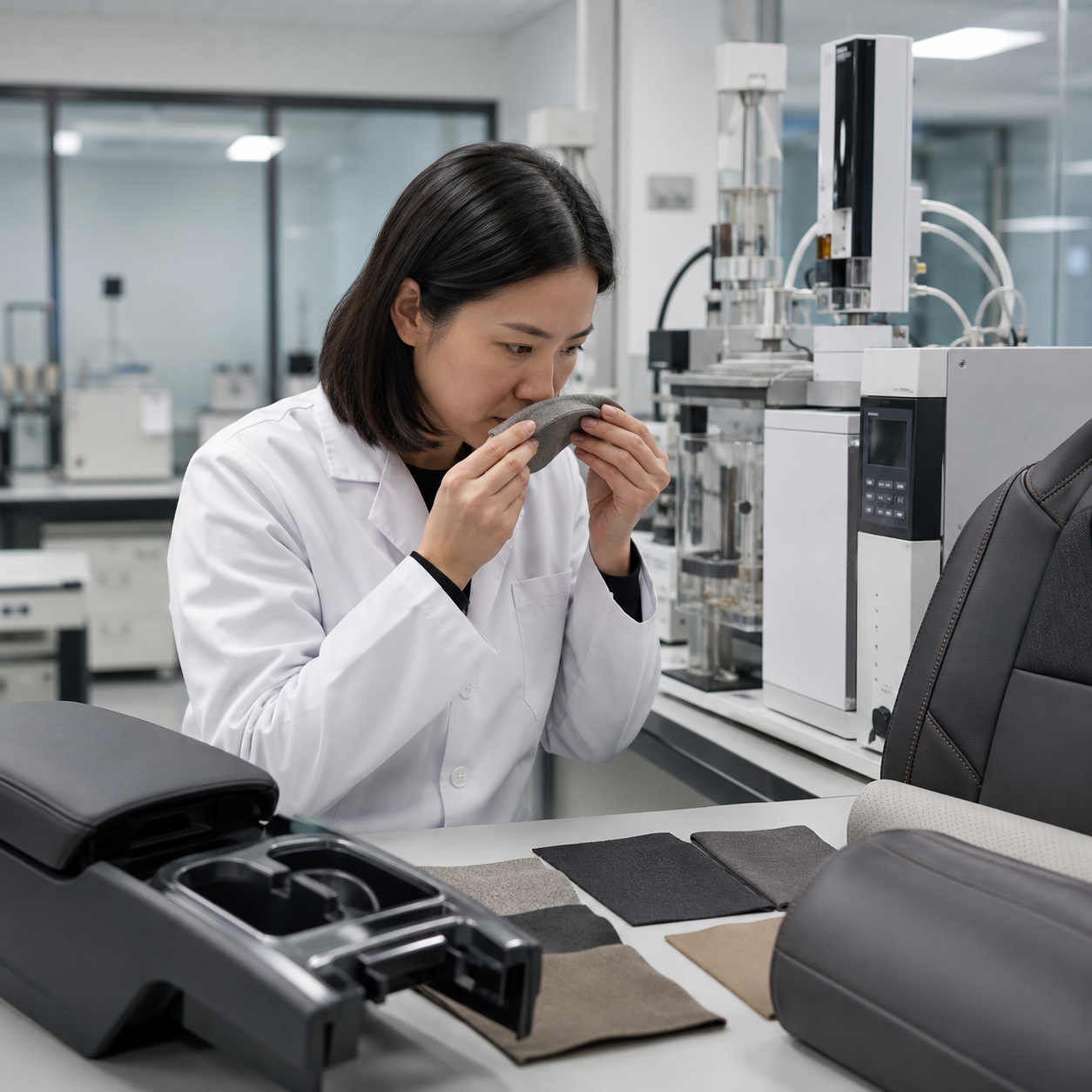
VOC Test for Odour Investigation and Automotive Material Control
A new vehicle smell can originate from various cabin materials such as plastics, foam, adhesives, textiles, sealants, coatings, and insulation, which may release different compounds, especially when exposed to heat during storage or use. A VOC test provides analytical data that helps manufacturers investigate emissions, compare production samples, and identify materials associated with unusual odours or elevated volatile compounds.
How VOC Emissions Develop in Automotive Materials
Volatile organic compounds originate from materials, additives, solvents, and processes, with emissions varying by formulation and conditions.
- Raw material composition
- Type and amount of adhesive
- Curing time and temperature
- Storage conditions
- Component age
- Packaging method
- Exposure to heat or sunlight
- Surface coatings and treatments
- Production batch variation
A material that produces acceptable results under one condition may release more compounds after extended storage or high-temperature exposure. Testing conditions must therefore reflect the relevant customer method or intended investigation.
Using VOC Testing to Investigate Automotive Odours
Odour assessment and VOC analysis offer different insights: human evaluation describes smell, while lab analysis identifies emitted compounds for comparison
| Sample Group | Purpose of Comparison |
| Normal and odorous components | Identify differences linked to the reported odour |
| New and aged materials | Evaluate changes during storage or use |
| Approved and alternative suppliers | Compare emission profiles |
| Before and after curing | Check the effect of processing conditions |
| Separate material layers | Locate the main emission source |
| Different production batches | Investigate manufacturing variation |
Testing complete components shows combined emissions, while separate material tests help identify sources; results should be reviewed with odour and production data.
VOC Testing Across the Production Process
VOC analysis can be used at several stages, from material selection to investigation of finished vehicles. Each stage requires a different sample strategy and testing objective.
Raw Material Evaluation
Testing raw plastics, foam, fabrics, adhesives, and coatings helps manufacturers compare materials before approval for automotive use
- Initial material screening
- Supplier qualification
- Formulation comparison
- Lower-emission material selection
- Verification after a supplier change
Process Validation
Heat, curing, mixing, coating, and bonding conditions influence emissions from finished parts, so process validation compares samples under varying conditions
- Adjusting curing temperature
- Extending drying time
- Changing adhesive quantity
- Replacing a cleaning chemical
- Modifying storage conditions
- Moving production to another line
Finished Component Assessment
A completed door panel, seat component, dashboard part, carpet, or headliner may combine emissions from several materials. Testing the finished component shows the overall result after assembly.
This information can be used for customer approval, production validation, or comparison with specified limits.
Selecting the Appropriate VOC Test Method
Different methods are designed for different sample sizes, emission ranges, and reporting requirements. Selecting the right VOC test approach depends on matching the procedure to the customer or OEM specification.
| Testing Approach | Typical Purpose |
| Thermal desorption testing | Analyse compounds released from a small material sample |
| Bag testing | Collect emissions from components under controlled conditions |
| Chamber testing | Evaluate emissions from larger parts or assembled materials |
| Formaldehyde analysis | Measure formaldehyde or selected carbonyl compounds |
| Fogging evaluation | Assess substances that may condense on glass surfaces |
| Odour testing | Evaluate the strength or character of perceived odour |
Some tests report individual compounds or grouped emissions, and results vary with conditions, so methods must be confirmed before sampling
Sample Handling for Reliable VOC Results
Volatile substances may change after sampling; packaging, storage time, and external chemical exposure can affect laboratory results.
- Using clean, low-emission packaging
- Sealing samples soon after collection
- Keeping different materials in separate packages
- Recording the production date and batch
- Identifying the sampling location
- Avoiding contact with cleaning agents or fragrances
- Recording curing and conditioning history
- Providing normal comparison samples
- Following the required sample dimensions
- Sending the applicable OEM specification
The laboratory should know the objective and, for complaints, receive details on odour timing, conditions, location, storage, and affected batches
Applying VOC Test Results to Material Decisions
VOC data supports material and process decisions, but results must be interpreted under correct test conditions and specifications for accuracy
- Compare candidate formulations
- Identify production batch differences
- Review adhesive or coating selection
- Adjust curing conditions
- Investigate storage-related changes
- Verify corrective actions
- Assess supplier consistency
- Support customer submissions
A higher result does not confirm the cause; review compounds with odour, materials, records, and trends across batches for control
VOC Testing Services in Malaysia
Malaysia produces automotive plastics, interior trim, textiles, foam, adhesives, electronics, and assembled components for global supply chains, often requiring emission testing during development, supplier approval, process validation, and complaint investigation; Alstesting VOC testing services in Malaysia help manufacturers evaluate emissions, formaldehyde, fogging behaviour, and potential odour sources, while detailed material data, production history, and correct methods support accurate analysis and effective quality control.